In the intro blog to my AI in medicine series I talked about how I would go through the different types of AI and how they are used in medicine… so here we are!
So what are the types of AI
There are many different types of technology under this umbrella term. As this blog focuses on medicine I will focus on a few key ones that are being used quite extensively in medicine. These can all be considered subsets under the wider AI umbrella. Additionally, some of the terms are not .. fixed… you will find many different terms and definitions in this field which might refer to the same thing, so I will cover some of the big types in this series but you will likely come across many more when doing your own research!
In this blog I will focus on machine learning and deep learning, these are all under the AI umbrella- machine learning is a subset of AI and deep learning is a subset of machine learning – look at this diagram below (took me annoyingly long to make on canva so please do appreciate it)
Click on the machine learning and deep learning and considerations for their applications in medicine sections to read more!
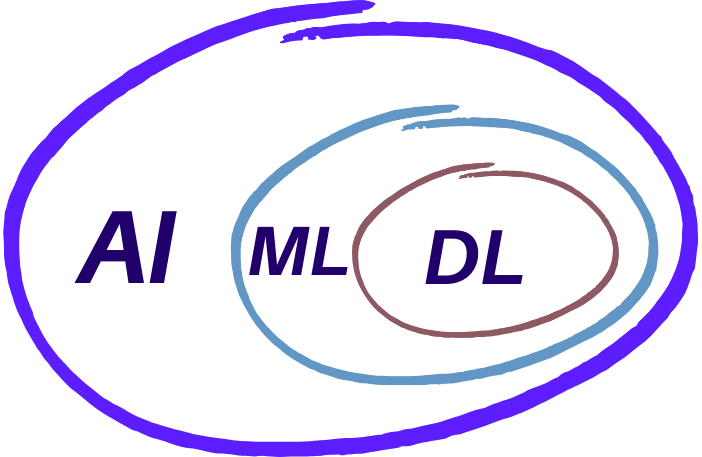
Machine Learning and Deep Learning
Machine learning refers to computer algorithms that can ‘learn’ from the data they analyse and adapt accordingly to help make accurate predictions.
This type of AI is all about optimising the output – having minimal errors and the most accurate predictions from the data – to understand a bit more lets understand what an algorithm is.
An algorithm is a set of instructions we tell a computer to do so it can perform a specific task e.g. you can code for a calculator to do calculations in a specific way or code for text to appear is a certain way. In these examples the human is telling the computer what to do and what not to do, and if we need a different calculations we would have to go and code for that.
In Machine Learning the computer algorithms learn and change their algorithms accordingly without humans having to tell them to do so. An example is using a ML algorithm to differentiate between different plants e.g. if its a tree, bush, flower. Once the ML algorithm is trained on data it should then theoretically be able to sort out images of plants into these categories
Now, with machine learning you still require human input – specifically, the data needs to be codified by humans. So in this example the pictures of plants would need to be sorted out by humans into categories such as tree, bush, flower and the ML algorithm trained on this before it can be used. For example humans may say if it has a trunk it is a tree and label the data as such and the machine learning will understand that label of trunk=tree
Deep learning is a subset of machine learning which can detect patterns in large data sets and does not necessarily need the data to be codified. Deep learning is characterised by the use of what we call neural networks (i’ll make a post explaining them). Very simply neural networks are a multiple ‘filter’ layers which information passes and is inspired by how information is processed by our own brains. Now this allows for complex analysis of information which ‘conventional’ machine learning cannot achieve. So this makes deep learning much more useful when it comes to ‘generative’ AI – think of chatGPT and image generating AI.
In terms of medicine – both can be incredibly useful and deep learning algorithms are attracting a lot of attention being used in applications such as image analysis – think of algorithms can can read radiology scans and detect tumours; generative AI that can create referral forms automatically; genomic applications where these algorithms are being used to analyse anything from DNA to RNA to histone modifications!
So it’s important you understand these two subsets of AI to understand how its being applied in medicine,
Now we should touch on two ‘types’ of learning that you need to understand.
Supervised and Unsupervised
For supervised learning lets go back to our plant example. The images have to be labelled by humans for the algorithms to be trained. This is what we call structured data i.e. it has been sorted and categorised. Supervised leaning uses this type of data to train algorithms and this has the advantage of potentially being more accurate.
Now for unsupervised learning it is not necessary to have structured data rather the algorithms can process unstructured data. Unstructured data is data that is unlabelled and not categorised by humans.
So in the plant example the computer algorithm would find the features that tell apart trees and bushes e.g. trunks, by itself, and not need humans to label the data for it
This is really important as most data is unstructured and making structured data out of this would be incredibly time consuming and expensive. One potential negative is that these algorithms have more potential to be inaccurate.
Now both machine learning and deep learning can carry out supervised and unsupervised learning. So machine learning is the superset and has other technologies within it other than deep learning which can carry out unsupervised learning. Additionally, Deep learning can use supervised learning methods.
So one way to think of this is conventional Machine learning is great for optimising known outcomes and making very accurate predictions,
Whereas deep learning is great at finding new patterns and relationships in data
Considerations for their application in healthcare
This is really important for you to understand. In health care we obviously cannot have large margins for error so we need highly accurate models. We also need to understand how decisions are made which brings up the first thing to consider about this technology.
Deep learning relies on ‘Neural networks’ which are effectively layers of filters where the data gets processed – inspired by how our own brain works – I will make a blog post explaining this too,
Sometimes, these neural networks can become incredibly complex, leading to the black box effect,
As there are many layers we don’t get a great view of how these algorithms work at times – we can just see the output, which isn’t ideal if we want to understand how decisions are being made, additionally, if the output for any reason is wrong we can’t understand why its wrong – a bit of an obvious issue if you dealing with algorithms analysing if you have lung cancer for example…
Now as medicine is a highly regulated field this issue should not be a major issue present in software on the market or being developed for the market, as they will have to comply with LOTS of regulatory frameworks which should ensure their algorithms are traceable. However, just because something should not be an issue does not mean it will not be an issue, and this is something everyone should be quite aware of when understanding or using AI systems. There are currently efforts to help make neural networks that can be explained and I will cover these in another blog post.
I will be making another blog post dedicated to this topic of advantages and limitations of using this technology in medicine so look out for that!
Hope you enjoyed this post – let me know what else you would like to learn about and if you had any thoughts on this post
I will be making others on the other different types of AI and on some big considerations people should have when using this technology
As always follow this blog if you like and follow my social media accounts for regular updates too!
Resources to learn more
I will always try to include a link to resources – these are websites and resources I found helpful and want to share with you guys,
heres a link to the resource page for this topic – do let me know if you know any other good resources you think I should add on
 Medtechexplainer
Leave a comment